Health Technology · AI · Founder
Check Me
AI-powered women’s health and breast-cancer early detection
- Role
- Founder & CEO — product, engineering, fundraising, clinical partnerships
- Timeline
- 2023 — Present
- Stack
- ReactFastAPILangChainOpenAIPythonFigma
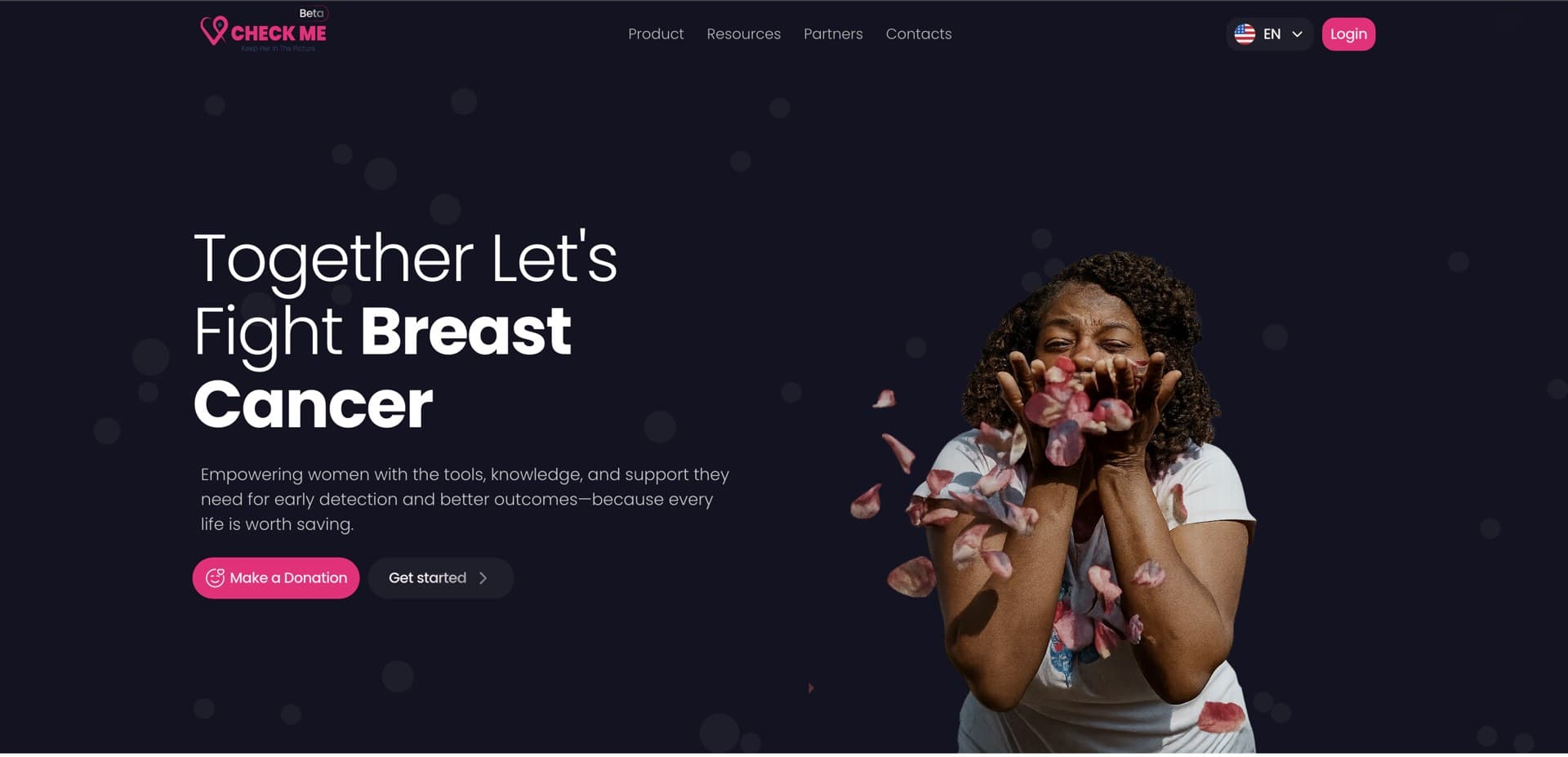
Check Me is an AI-powered women’s health and breast-cancer early-detection platform. It helps women understand their bodies, prepare for screening, and reach care earlier—in communities where late detection is still the norm.
Problem & context
In many underserved communities, breast cancer is detected late—often because reliable health education, screening guidance, and clinical access are out of reach. The cost of that gap is measured in lives.
Check Me set out to close the distance between “I have a question about my health” and “I know what to do next”: guided self-examination, screening readiness, and a clear path to professional care.
My role
I founded Check Me and lead it as CEO and technical lead. That means owning product strategy and the engineering architecture, writing production code, raising funding, and building clinical partnerships. I led the team through research, design, build, and launch—then through growth to more than 10,000 users.
Users & constraints
The platform serves women in underserved communities, many on low-bandwidth connections and entry-level phones. Every product decision had to respect three constraints: medical responsibility (no diagnosis, no false certainty), accessibility (low data, simple language), and trust (health is personal; the product must feel safe).
Product approach
Rather than a single-purpose app, Check Me is built as a set of connected experiences that meet users at different stages of their health journey:
- Guided breast self-examination with step-by-step support
- Screening-readiness tools and a risk-band interface that communicates without alarming
- A personal health journal with pattern detection over time
- Community circles and stories for peer support
- Referral workflows connecting users to healthcare professionals
- Engagement streaks, badges, and notifications that build a monthly habit
- Nia, an AI health companion for questions users may hesitate to ask a person
Architecture & technical approach
The backend is a FastAPI service designed around async inference so AI features stay responsive in low-bandwidth, remote-clinic environments. Nia—the AI companion—runs on a retrieval-augmented generation pipeline over trusted medical content (covered in its own case study). We also trained an ultrasound image-analysis model as part of the platform’s longer-term diagnostic roadmap, alongside an IoT-enabled ultrasound initiative that increased patient access by 40%.
Decisions & tradeoffs
The hardest decisions were about restraint. We deliberately kept AI outputs educational rather than diagnostic, and we invested in referral workflows to real clinicians instead of pretending software could replace them. We prioritized habit-forming features—journals, streaks, circles—because early detection is a behavior, not a one-time event.
Outcome & impact
Check Me has reached more than 10,000 users, raised over $75,000 in funding and support, won the WSIS e-health prize at the ITU World Summit in Geneva, and received the Nebius AI Discovery Award in London. More important than any single number: the platform gives women a structured, trustworthy way to act on their health earlier.
Lessons learned
- In health products, trust is the core feature—every technical decision either builds it or spends it.
- Constraints like low bandwidth force better architecture, not worse products.
- A founder who codes can move fast, but partnerships (clinical, funding, community) are what make the product real.