Enterprise Software · AI Platforms · Full-Stack
Enterprise AI Platforms
Production AI systems at Tata Consultancy Services
- Role
- AI & Data Engineer — full-stack development across internal and client platforms
- Timeline
- 2025 — Present
- Stack
- FastAPINext.jsReactTypeScriptPythonSupabase
Internal / confidential product — details generalized, no client data shown.
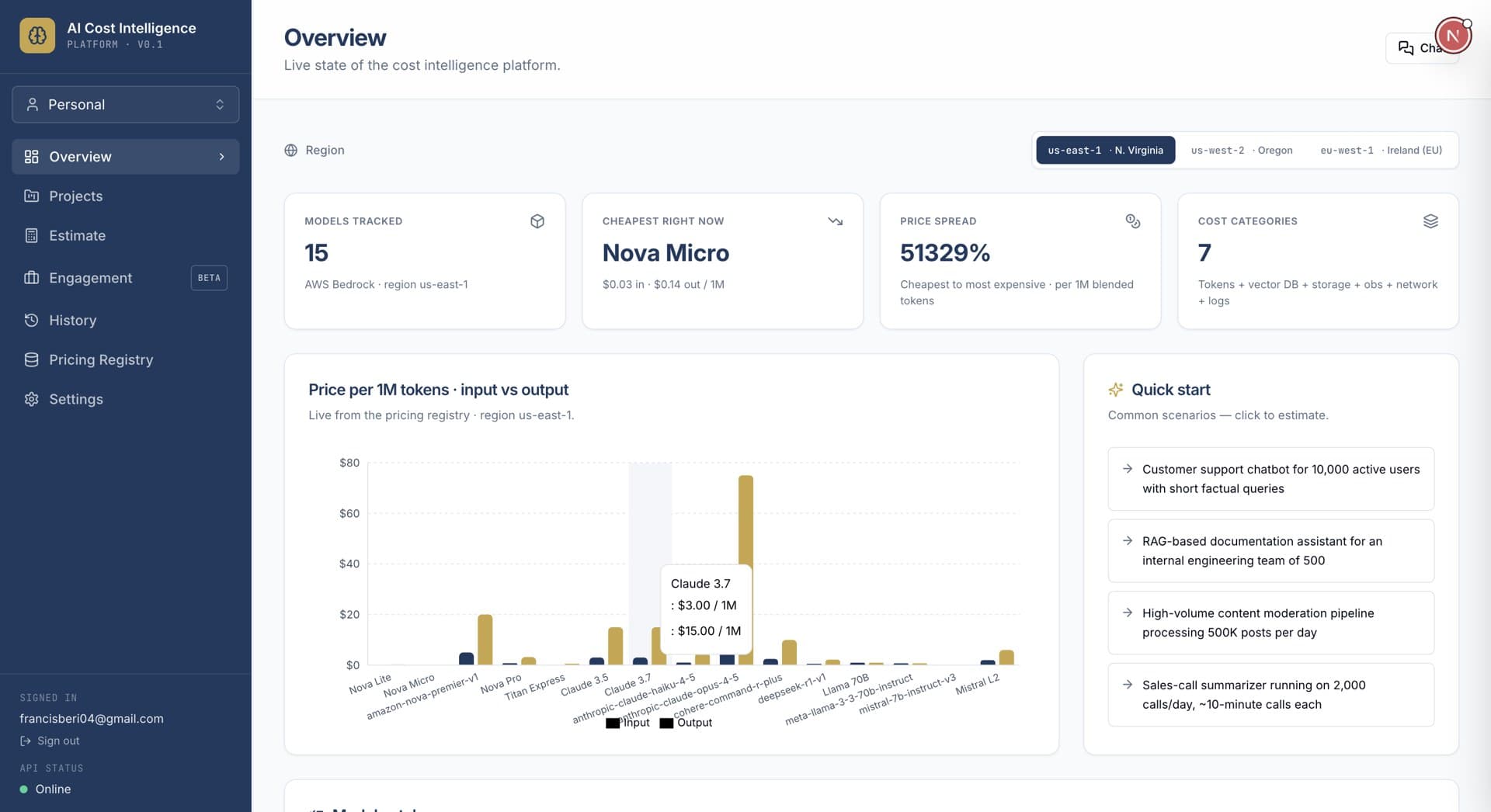
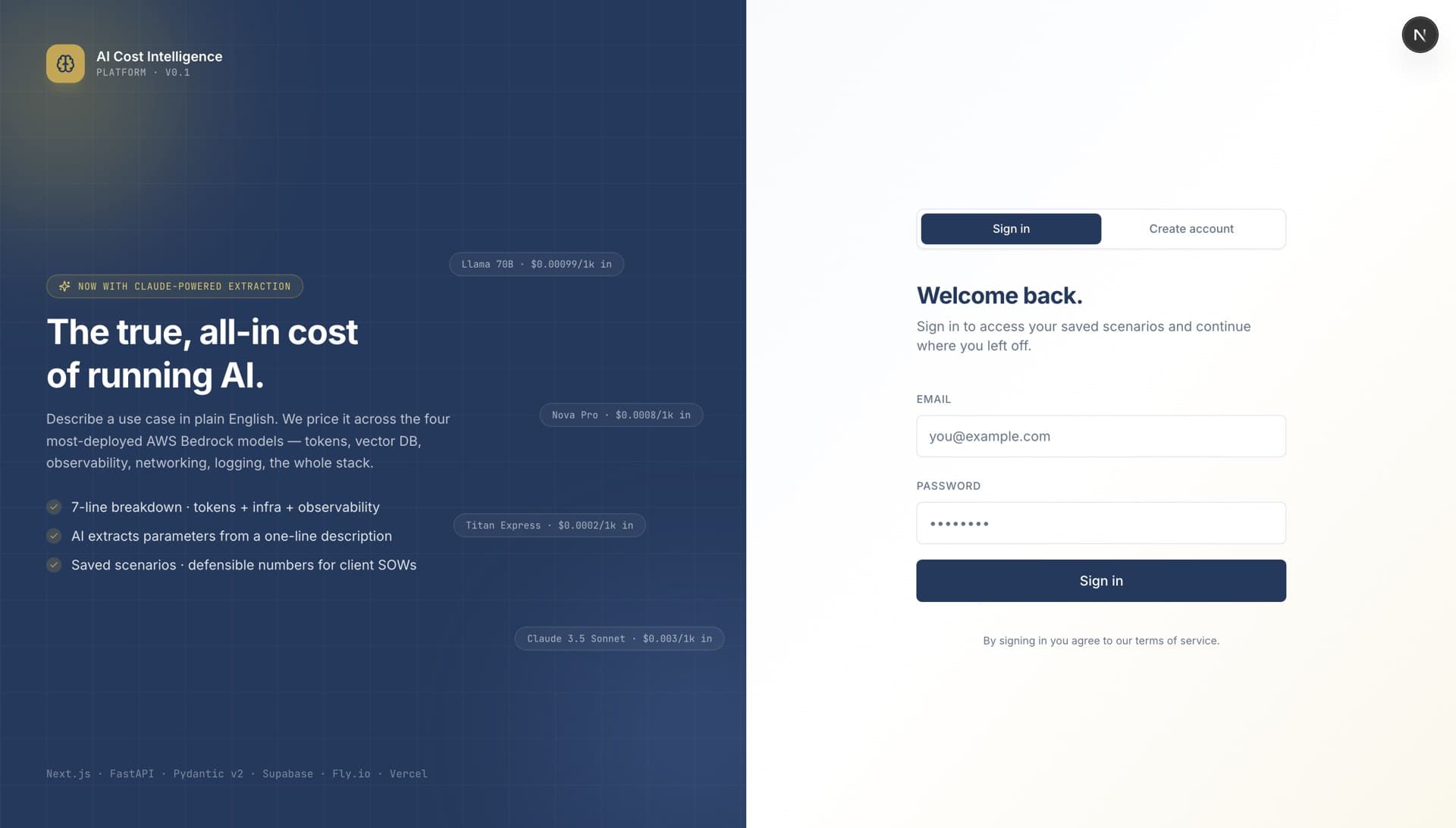
At Tata Consultancy Services I build production AI platforms used by consultants and enterprise clients. The products below are internal or confidential, so this case study describes generalized architecture and my contribution rather than client specifics. The screens shown are from the AI cost-intelligence platform and contain no client data.
Problem & context
Enterprises adopting AI face two practical problems: nobody can tell them what running AI actually costs across providers, and their specialist teams lose enormous time to manual process work. My work at TCS attacks both.
AI cost-intelligence platform
I built, from scratch, a platform that helps consultants calculate the real cost of running AI workloads—covering 21 language models across four providers. It’s a multi-tenant SaaS system: authentication and role-based access control, tenant isolation, soft-delete workflows, and project-level reporting, built with Next.js on the front and FastAPI with Supabase behind it.
- Multi-tenant architecture with strict tenant isolation
- Authentication and role-based access control
- Soft-delete workflows and project-level reporting
- Cost modeling across 21 LLMs and four providers
AI tooling for consultants
I worked on Prism, an internal tool that uses AI agents to automate requirements gathering and process documentation for SAP consultants—cutting manual effort by 50% and helping teams start projects faster. I also built Loom, a dashboard component kit that turns a simple intake form into custom, on-brand client dashboards.
Healthcare AI control plane
For a healthcare payer, I designed and implemented a white-label AI control plane with advanced RBAC, human-in-the-loop claim adjudication, and end-to-end data lineage—so AI-assisted decisions stay auditable and humans stay in charge of consequential calls.
Decisions & tradeoffs
The recurring theme in enterprise AI is governance: multi-tenancy done properly, permissions that mirror real organizations, and humans in the loop wherever the output touches money or health. The engineering is less about clever models and more about making AI dependable inside systems businesses already trust.
Outcome & impact
These platforms are in production use inside TCS and with enterprise clients. Specific business outcomes are confidential; the measurable results I can share are the 50% reduction in manual consultant effort from Prism and the delivery of the cost platform from empty repository to production.
Next.js client
per-tenant theming & RBAC-aware UI
Auth layer
roles, permissions, tenant context
FastAPI services
business logic & AI orchestration
Tenant-isolated data
Supabase/Postgres, soft deletes, lineage
LLM providers
multiple models, cost tracked per call
Generalized for confidentiality — internal product details omitted.
Lessons learned
- Enterprise AI succeeds on governance—tenancy, permissions, and auditability—before it succeeds on model quality.
- Human-in-the-loop isn’t a compromise; for consequential decisions it’s the product.
- Building from scratch inside a large company still rewards startup habits: ship, measure, iterate.
Product screens
Links
This is an internal product — public links aren’t available.